

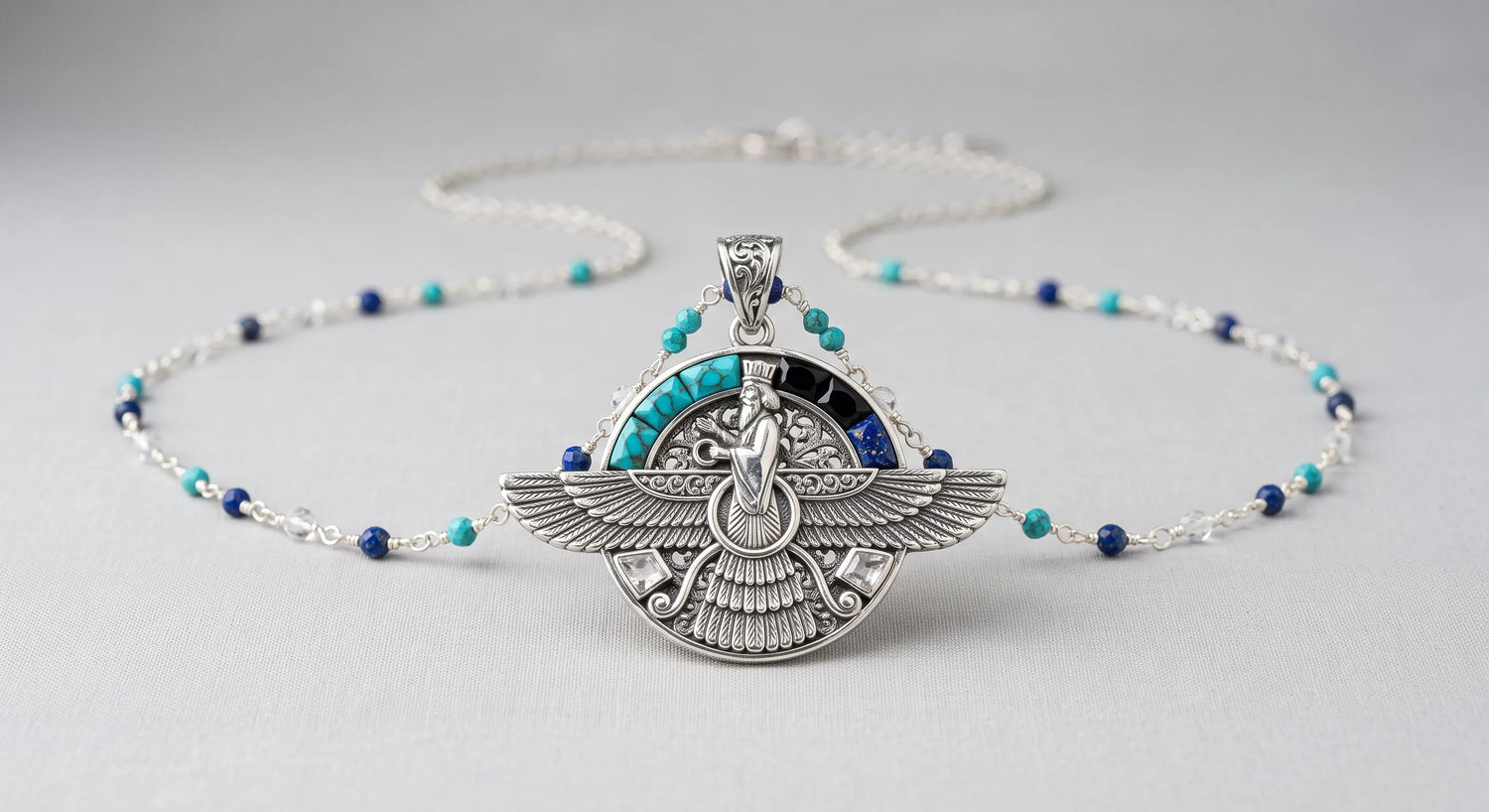
The Faravahar symbol is one of the most recognizable images associated with ancient Persian culture and Zoroastrianism. A human figure rises from a winged disc, one hand lifted and the other holding a ring. Today, this powerful emblem appears on Persian jewelry, temple walls, architectural reliefs, artwork, and objects carried by Iranian communities around the world.
Its appeal, however, extends beyond its visual beauty. The Faravahar is widely understood as a reminder that human beings possess moral agency: the capacity to direct their thoughts, language, and actions toward truth. This ethical vision is often summarized by the Zoroastrian principle of good thoughts, good words, and good deeds.
The symbol’s historical meaning is more complex than popular explanations sometimes suggest. Scholars do not agree on precisely what it represented to the ancient Persians, and many familiar interpretations of its individual elements are modern. Understanding that uncertainty does not diminish the Faravahar. Instead, it reveals how an ancient royal image became a living symbol of spiritual responsibility, Persian identity, personal empowerment, and protection.
The Historical Origins of the Faravahar Symbol
From the ancient Near Eastern winged disc to Achaemenid Persia
The Faravahar belongs to a long tradition of winged-disc imagery found across the ancient Near East. Related forms appeared in Egyptian, Mesopotamian, and Assyrian art before the rise of the Achaemenid Persian Empire. In Neo-Assyrian iconography, for example, a human or divine figure could appear within a winged disc associated with the god Ashur, royal authority, and divine favor.
Persian artists did not merely reproduce this inherited visual language. Under the Achaemenid kings, they adapted it to the political, ceremonial, and religious environment of an empire extending from Central Asia and the Indus Valley to Egypt and the Mediterranean.
Examples appear in royal settings such as Persepolis and Behistun, where the winged figure is positioned above kings, attendants, or monumental inscriptions. Its placement connects it with legitimate rule, divine order, royal fortune, or spiritual authority. Yet no surviving Achaemenid text provides a definitive caption explaining the image. Claims that every feather, curve, and gesture had one fixed ancient meaning should therefore be treated cautiously.
The image now called the Faravahar may have represented several related ideas rather than one narrowly defined concept. Proposed interpretations include divine favor, the king’s guardian spirit, royal glory, spiritual power, or divinity more generally.

Fravashi, divine grace, and the problem of certainty
The modern name Faravahar is commonly connected with fravashi, an important concept in Zoroastrian tradition. A fravashi can be understood as a pre-existing spiritual essence, protective presence, or higher spiritual identity associated with a person. It should not be reduced too quickly to the Western idea of a “guardian angel,” although that phrase can provide an approximate point of reference.
In some Zoroastrian accounts, the fravashi guides the embodied soul toward truth and supports it in the moral struggle against deception and destructive choices. This understanding helps explain why the Faravahar has come to signify the higher self, spiritual guardianship, and the soul’s responsibility to choose the good.
Other scholars associate the Achaemenid winged figure with khvarenah, or divine glory and legitimate fortune. In this interpretation, the emblem expressed the favor that enabled a ruler to govern justly. A king who abandoned truth and order could not simply assume that divine legitimacy remained his permanent possession.
These interpretations are meaningful, but they are not proven translations of the ancient image. Most detailed readings familiar today were formalized long after the Achaemenid period. A historically responsible interpretation therefore holds two ideas together: the Faravahar is deeply connected with modern Zoroastrian and Persian identity, while its exact function in antiquity remains open to debate.
The Spiritual Meaning of Good Thoughts, Good Words, and Good Deeds
The ethical triad commonly rendered as good thoughts, good words, and good deeds is central to the modern spiritual meaning of the Faravahar. In Avestan terms, it is expressed as Humata, Hukhta, Hvarshta. These are not three unrelated virtues. They describe a continuous moral process in which inner intention becomes speech and speech becomes action.
Good thoughts: governing the inner life
Good thoughts do not require forced positivity or the denial of grief, anger, and uncertainty. In a Zoroastrian ethical framework, goodness is more closely related to clear judgment, truthfulness, wisdom, and alignment with constructive order.
Thought is the beginning of moral participation. Resentment may become harmful speech; disciplined reflection may become justice or compassion. The Faravahar can therefore function as a visual pause: a reminder to examine the motives behind a decision before those motives enter the world.
For someone wearing Faravahar jewelry, touching or seeing the symbol can become a personal mindfulness cue. The question it raises is practical: “Is this thought leading me toward truth, or is it strengthening confusion and harm?”
Good words: speech as moral action
Zoroastrian philosophy gives language ethical weight. Words can clarify truth, preserve dignity, and repair trust, but they can also manipulate, humiliate, or spread falsehood. Good words require more than politeness. They involve accuracy, moral courage, restraint, and responsibility for the consequences of communication.
This principle is particularly relevant in digital life, where impulsive language can travel far beyond its original context. A Faravahar necklace or ring may serve as a quiet commitment to speak honestly without using honesty as an excuse for cruelty.
Good deeds: turning belief into visible responsibility
Good deeds complete the movement from intention to consequence. They may include protecting the vulnerable, fulfilling promises, caring for family, resisting injustice, practicing generosity, or performing ordinary work with integrity.
This emphasis prevents the Faravahar from becoming only a decorative spiritual motif. Its deepest contemporary value lies in accountability. Wearing the emblem does not confer virtue automatically; it can remind the wearer that character must be expressed through repeated choices.

Faravahar Jewelry for Personal Empowerment and Spiritual Protection
How an ancient emblem becomes a wearable intention
Jewelry brings symbolism into physical contact with daily life. Unlike an image displayed in a museum or monument, a Faravahar pendant travels with the wearer through work, relationships, conflict, celebration, and private reflection. This continuity makes it well suited to intentional spiritual practice.
Personal empowerment, in this context, does not mean domination or guaranteed success. It means strengthening the ability to act from one’s values. The Faravahar can support that process by representing moral independence, perseverance, cultural memory, and the higher standard to which the wearer chooses to return.
For people of Persian or Iranian heritage, Faravahar jewelry may carry an additional dimension. It can preserve a connection to pre-Islamic history, family memory, and a cultural identity that has survived migration and political change. The emblem disappeared from widespread Persian artistic use for long periods, then gained renewed visibility during the twentieth century. After 1979, it remained especially prominent among Iranians and diaspora communities as an expression of heritage that is not limited to formal religious observance.
For wearers outside that heritage, respect begins with understanding. The Faravahar is not a generic winged charm. Learning its Persian and Zoroastrian context helps prevent a living cultural symbol from being reduced to an exotic ornament.
What spiritual protection can responsibly mean
In metaphysical jewelry, “protection” is often described as if a pendant creates an invisible shield or guarantees immunity from misfortune. Such claims cannot be established historically or scientifically.
A more grounded understanding of Faravahar spiritual protection focuses on orientation. A meaningful symbol may help protect the wearer’s attention from impulsiveness, dishonesty, fear-driven decisions, or the loss of personal direction. It can reinforce boundaries and encourage deliberate conduct, but it does not replace medical care, practical safety measures, or professional support.
Some wearers combine the Faravahar with gemstones chosen for complementary symbolic associations. Black onyx or obsidian may represent grounding and boundaries; turquoise has longstanding importance in Persian decorative traditions and is often associated with protection and good fortune; lapis lazuli may evoke wisdom and truth; clear quartz is commonly used in contemporary metaphysical practice as a symbol of clarity and amplified intention.

Choosing Faravahar jewelry with cultural and material integrity
A meaningful piece should be evaluated by more than its appearance. Look for a clearly rendered figure, balanced wings, secure attachment points, and finishing that preserves the iconography rather than turning it into an indistinct silhouette.
Material quality also affects longevity. Sterling silver should be identified as 925 silver, while gold jewelry should carry an appropriate purity mark. Gold vermeil generally provides a thicker precious-metal layer than ordinary flash plating, although wear still depends on thickness, use, and care. Gemstone listings should distinguish natural, treated, reconstructed, and synthetic stones.
Ethical product descriptions should explain the Faravahar’s cultural context without claiming that historians know the exact ancient meaning of every visual feature. They should also avoid promises that the jewelry can cure illness, repel all negative energy, or produce wealth.
Once selected, the jewelry can be incorporated into a simple personal ritual:
- Define one value the piece will represent, such as truthful speech or courage.
- Hold or touch it before a difficult conversation or decision.
- Ask whether your thought, language, and intended action are aligned.
- Review the outcome without self-punishment and identify what should change.
- Clean and store the piece carefully as an act of respect for both the object and its meaning.
Conclusion: Wearing the Faravahar as a Living Ethical Commitment
The Faravahar has traveled through several layers of meaning. It emerged from the broader winged-disc tradition of the ancient Near East, became part of Achaemenid Persian royal imagery, and was later interpreted through Zoroastrian ideas of the fravashi, divine order, and spiritual responsibility. In the modern era, it has also become an enduring symbol of Persian identity and cultural resilience.
Its most valuable message is not that a symbol can do moral or spiritual work on a person’s behalf. It is that every person participates in shaping the world through thought, speech, and action.
When worn as metaphysical jewelry, the Faravahar can channel that philosophy into a daily practice of personal empowerment. Its protection is best understood as remembrance: remembering one’s values under pressure, maintaining integrity when compromise is easier, and choosing constructive action when fear or confusion threatens to take control.
In that sense, a Faravahar necklace, ring, or bracelet becomes more than an accessory. It becomes a personal covenant with three demanding principles: think with wisdom, speak with truth, and act for the good.


Hinterlasse einen Kommentar
Diese Website ist durch hCaptcha geschützt und es gelten die allgemeinen Geschäftsbedingungen und Datenschutzbestimmungen von hCaptcha.