


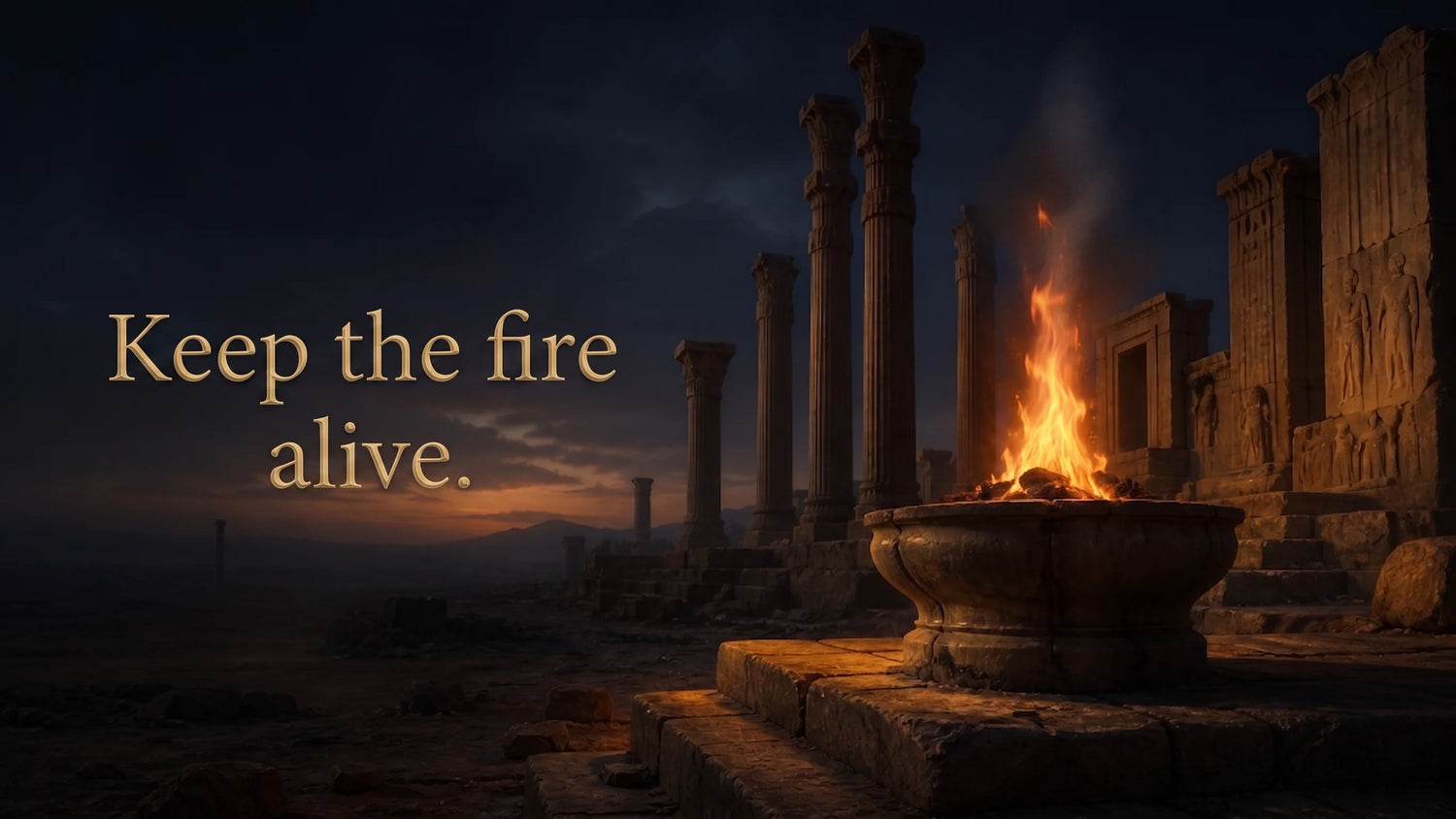
At some point in life, everyone suddenly realizes:
What truly exhausts us may not be having too much to do, but watching those things slowly lose their meaning.
We keep working, studying, planning, traveling, and reaching one goal after another. We keep moving forward, yet we may not know where we are going.
· Some people begin to question their passion.
· Some still have the ability, but no longer have the courage to begin.
· Some appear perfectly fine on the outside, while inside they feel like a room that has not been lit for a very long time.
The story of Amesha begins with a question like this:
On the long and uncertain journey of life, what makes a person willing to keep believing, keep going, and reignite the flame within?

We did not find the answer right away.
Because this question does not belong to any one philosopher or any single religion. For thousands of years, people in different lands and different eras have continued to ask it in different forms.
· When an empire falls, how do people continue to live?
· When a homeland no longer belongs to them, how do people preserve their identity?
· When memories cannot be completely preserved in stone, how can they be passed on to the next generation?
In the ruins, rituals, and objects left behind by ancient civilizations, we see a symbol that appears again and again:
Fire.
Fire can light the darkness, but it can also bring danger. It can warm people, but it can also destroy cities. Yet throughout human civilization, fire has never been merely a natural phenomenon.
It was the first force of nature that human beings transformed into a symbol of communal life.
People gathered around fire, used it to protect themselves from the cold, cooked their food with it, and told stories, performed rituals, and remembered their ancestors in its glow.
Fire means that life is still continuing.
It also means that someone is willing to stay and care for it.

What Makes a Flame Truly Precious Is Not That It Never Goes Out
We often speak of “eternity”—a word that sounds firm, complete, and unshakable, like a monument that stands forever. But when we look back at history, we discover that most things called “eternal” were not things that never experienced interruption. Rather, after being lost, forgotten, or broken time and again, they endured because someone chose to bend down, gather the embers, relight the flame, and choose to protect it once more.
There is a fundamental difference between these two ideas.
“Never going out” is a myth—a perfect arc that exists only in the imagination. “Going out, yet being relit” is closer to the true human condition. It is rough, winding, and imperfect, but it resembles the paths we have actually traveled. It also comes closer to the true character of civilization: not never falling, but always having someone who remembers what the flame looked like after every fall.
The ancient Persian tradition of fire unfolded within this complicated history. In the Zoroastrian tradition, fire was not simply an object of “fire worship.” It was regarded as a symbol of purity, order, truth, and moral choice. Its importance lay not only in its ability to burn, but also in the way it reminded people that they were responsible for their own thoughts, words, and actions.

In other words, fire does not make choices for us.
It simply makes our choices easier to see.
When we gaze into a flame, we may not see a supernatural force. Instead, we see an ancient and simple truth: our inner state also needs to be cared for.
It can grow dim because of fear, weaken because of exhaustion, or become almost invisible because of disappointment. But as long as someone is willing to draw near, add fuel, and shield it from the wind and rain, it can still grow bright again.
This is what Amesha understands as the “inner flame.”
· It is not a permanently elevated emotional state, nor a continuous state of success.
· It can be the ability to begin again after failure.
· It can be the ability to preserve sound judgment in the middle of chaos.
· It can be the refusal to betray your values, even when no one is applauding.
From Pasargadae to Persepolis: How Civilizations Leave Their Values in Stone
Pasargadae, in southern Iran, still preserves traces of the early Achaemenid civilization. It is associated with Cyrus the Great and witnessed the founding of the Persian Empire.

Today, when people stand before these ruins, they usually notice the monumental columns, palaces, and tombs first. But what a civilization truly leaves behind is rarely limited to its architecture. Stone can preserve form, but it cannot preserve meaning on its own. Meaning must be continually interpreted, passed down, and understood anew.
The remains of stone fire altars and fire vessels discovered near Pasargadae offer another clue: from the very beginning, fire was more than a part of daily life. It had already been placed within stone and connected to kingship, family, and the order of civilization.
Cyrus’s legacy was not simply conquest. In later accounts, he was often described as a ruler who valued order, governance, and coexistence among different peoples. Whether he personally belonged to what later came to be known as Zoroastrianism remains a subject of scholarly debate. However, archaeological and textual evidence indicates a close relationship between early Achaemenid kingship, Iranian religious traditions, fire veneration, and the concept of Ahura Mazda.
At Pasargadae, we see an empire attempting to inscribe order, authority, and values into its architecture. Fire was placed within that vision as an object of shared contemplation. Regardless of their ethnic background, people could look into the flames and see the same light.
At Persepolis, this expression became even more monumental. Darius I began its construction, and Xerxes I continued to expand it. Envoys and representatives from different regions were carved into the stone walls, as if the entire empire had been frozen within a long stone narrative.

These reliefs do not directly tell us how people should live. But they leave us with an important question:
What truly holds different people together in a society?
· A shared land?
· Shared power?
· Shared memories?
· Or a value that lasts longer than power?
This is the true awe we feel at Persepolis. It was not merely a once-glorious royal capital. It was also a reminder about civilization: any grand structure can disappear, yet the meaning people collectively give it may continue in another form.
Buildings can be burned, while fire—as a symbol of order—can be carried away, hidden, and lit again.
When the Palace Burns, What Does a True Civilization Leave Behind?
In 330 BCE, Alexander entered Persepolis, and the royal palace was burned. Historians continue to debate the reasons for and the scale of the destruction, but the result was real and brutal: the symbol of an empire was consumed by flames. And yet this became the most important turning point in the story of Amesha.


Because a civilization never exists only inside its palaces. Cities can be burned, dynasties can end, and statues can be shattered. But people’s memories of their language, traditions, sacred objects, and ways of life do not automatically disappear.
Sometimes, the true continuation of a civilization takes place in places that seem to have left little historical record:
· A ritual still preserved by a family.
· A prayer still remembered by a priest.
· A name that an exile still refuses to abandon.
· An object carefully kept safe.
· And a flame carried away from the ruins.
An empire can lose its capital, while its people continue to preserve their beliefs. This is the most accurate meaning of the “eternal flame”: it does not necessarily represent the same physical fire burning without interruption. Rather, it represents a spiritual tradition that is relit after destruction.
Empires Disappear, but the Act of Guardianship Can Become a Civilization in Itself
From 224 to 651 CE, the Sasanian Empire ruled Iran and the surrounding regions. This period reunified the Persian world and strengthened the position of Zoroastrian traditions within the state and society. During this era, fire was no longer merely an abstract symbol. It gradually became part of religious institutions, royal authority, and community life.
· Fire temples needed people to maintain them.
· Rituals needed people to learn them.
· Sacred fires needed people to take responsibility for them.
And responsibility is rarely carried by a single person. It requires one generation to pass it to the next, and the next to pass it on again.

Historical sources mention Adur Gushnasp, one of the most important great fires of the Sasanian period. Its remains are located at present-day Takht-e Soleyman in northwestern Iran. The site shows that fire temples were not mysterious spaces detached from society. They were cultural centers closely connected to kingship, religion, geography, and political order.
This history invites us to reconsider the word “guardianship.”
Guardianship does not mean placing something inside a glass case and isolating it from the world.
True guardianship means allowing a tradition to enter real life, where it can withstand the test of time and the pressures brought by changing circumstances.
It requires discipline and patience.
It requires someone to continue performing seemingly small actions, even when no one is watching.
· Adding fuel.
· Cleaning.
· Praying.
· Waiting.
· Repeating.
Many important things have been preserved in exactly this way.
Not because they were always dramatic and magnificent, but because someone was willing to carry out, day after day, the work that few people noticed.
We believe the inner flame works the same way.
It does not always appear as intense passion.
Sometimes it is simply the small thing you still do every day; the few minutes you continue to set aside for yourself when life feels out of control; or your willingness to hear your own voice when everyone else is urging you to become someone different.
After the Arab Conquest: The Sacred Fire Begins Its Journey into Exile
In the seventh century CE, the Arab conquest transformed Iran’s political and religious landscape. As a new ruling order was established, some Zoroastrians gradually left Iran and migrated toward western India.

These migrants later formed the Parsi community.
When they arrived in India, they brought more than fire. They also carried their language, clothing, scriptures, festivals, food, wedding and funeral customs, forms of prayer, and memories of their ancestors and homeland.
According to Parsi traditional accounts, they established new settlements and fire temples in western India. Later, the Iran Shah Fire was moved and protected during times of war, eventually reaching Udvada in the eighteenth century, where it has continued to this day.

Over the course of centuries, a sacred-fire tradition was maintained, relocated, and reestablished through priests, communities, and rituals.
We do not need to claim that a single flame passed through every era without interruption.
What truly deserves to be remembered is not whether the fire existed in exactly the same physical form, but whether people repeatedly decided:
We will not allow it to lose its meaning.
· What they carried away was not merely a religious ritual.
· They carried away the memory of who they were.
· They transformed tradition from a geographic location into an identity that could be carried with them.
This is one of the most moving abilities of human beings:
· When people cannot take a city with them, they can still carry a way of life.
· When people lose their homeland, they can still redefine “home” on new soil.
· When the outside world keeps changing, they can still preserve an inner space they refuse to surrender.
Yazd: Not a Myth of Eternal Burning, but a Tradition of Constant Guardianship
In Iran, Yazd remains an important center of Zoroastrian culture.
The city is known for its dry desert environment, ancient settlement patterns, and religious communities that have continued to exist to this day. Its fire temples and local communities demonstrate how a religious minority can preserve its rituals and identity throughout a long and difficult history.

Many travel articles describe Yazd as home to “a sacred fire that has been burning for 1,500 years.” This claim is compelling and easy to share, but it can also create misunderstandings.
We prefer a different expression—one that is more accurate and, in many ways, more powerful:
Yazd preserves a sacred-fire tradition that has been guarded for centuries. It is not simply one single flame that can be proven to have remained unchanged from ancient times until today.
This distinction matters.
If we emphasize only the number of years, it becomes easy to reduce a real and complex cultural tradition to a sensational statistic.
What truly deserves respect in Yazd is not how many years this particular flame has been burning. It is the fact that countless specific individuals accepted the long and tangible responsibility of keeping the tradition alive.
They did not necessarily know what the future would bring.
Nor could they guarantee that the world would remain stable forever.
But they still chose, in their own time, to become temporary guardians.
From this perspective, “eternity” does not mean that something requires no help from anyone.
On the contrary, eternity is possible precisely because every generation contains people willing to take it into their hands.
Amesha: Bringing an Ancient Tradition of Guardianship into Modern Life
Looking back on this history, we see more than Persian dynasties, ancient ruins, and religious rituals. We see a choice to protect the light in the darkness.
The sacred fire has endured not because it never faced storms, but because in every era, someone was willing to draw near to it, care for it, and pass that responsibility on to the next generation. What it symbolizes is not only light itself, but also the ability to keep protecting what matters.
Each of us experiences our own moments of exile: leaving a familiar city, ending a relationship, facing failure, confronting loneliness, or suddenly reaching a point in life when we no longer know who we are. At such times, the inner flame may grow faint. But faint does not mean extinguished. As long as we are willing to pause and listen to our own voice again, it can still be rekindled little by little.
This is why Amesha chose natural crystals to tell a story about guardianship. Courage, hope, and commitment cannot be seen, but they can be remembered through an object that can be worn, touched, and carried with us.

Crystal is not the answer, and it will not change our fate for us. It is more like a small anchor. When the inner flame grows faint, it reminds us what we once believed in, what we are protecting, and whether we are willing to keep moving forward.
We do not replicate ancient fire temples, nor do we turn sacred symbols into simple decoration. What we hope to carry forward is the spirit behind the sacred fire: clarity, courage, protection, transformation, and hope.
Each Amesha piece can become a small ritual in daily life—the feeling of holding it during meditation, the reminder of a goal written down beside it, or the way it helps you confirm what you truly want to carry with you as you begin a new chapter.
When you wear it, it does not mean that you already possess all the answers. It represents a choice:
· To preserve a moment of clarity amid confusion.
· To refuse to give up on yourself when you are exhausted.
· To allow hope to return after disappointment.
· To protect what still matters in your heart while the outside world continues to change.
For thousands of years, dynasties have risen and fallen, cities have disappeared, communities have migrated, and languages have changed. Yet human beings have always searched for a way to keep the light from disappearing completely.
Sometimes that light was preserved in a temple. Sometimes it was written into ancient texts. Sometimes it was carried to another land by a group of people who had left their homeland.
And today, it can also exist in a deep breath, a fresh start, or the moment you decide to keep believing in yourself.
This is the story of Amesha.

It is not a story about a flame that never needs to be cared for.
It is a story about the people in every generation who were willing to reach out and protect it.


Commenta
Questo sito è protetto da hCaptcha e applica le Norme sulla privacy e i Termini di servizio di hCaptcha.