


You've felt different since you were a child.
Not better, not worse — just different. You can't quite put your finger on it, but something is off.
You don't laugh when other people laugh. You don't understand why everyone is anxious about the things they're anxious about. You sit in a classroom, an office, at a dinner table, surrounded by people, but you feel like an audience member watching a play you don't quite get.
When you look up at the night sky, you feel an inexplicable urge to cry. Not because you're sad — just that there seems to be something out there calling to you. You can't explain the feeling, but it's heavy. So heavy that you'd never dare bring it up with anyone.

Because you already know what they'll say.
"You're overthinking it."
"Are you depressed?"
"You're just too sensitive."
No one ever tells you: maybe this feeling is real. Maybe it's not a sickness, not a symptom of something that needs to be fixed. Maybe it's just your soul trying to tell you something.
A Word Growing Quietly Behind a Screen
Over the past few years, millions of people in America have come across a word on social media: Starseed.
It's not a religion. It's not an organization. It's not even a standardized doctrine. It's more like an identity option. Simply put — you're not broken, you're awake. You don't belong here because you were never from here to begin with. Your soul isn't an Earth native. You come from another planet, maybe even another dimension. You weren't born into this life to live an ordinary human existence — you're here on a secret mission.
Go on TikTok and search #starseeds. Hundreds of thousands of posts are sitting there. Some people ask, "How do I find out my galactic origin?" Others share their "star memories." Some write long posts late at night with titles like, "For the first time in my life, I don't feel alone."
It wasn't pushed by a single big influencer. There was no viral event that started it all. One person typed out a hashtag. Ten people saw it. Two of them started using it. And little by little, it grew into something you can't scroll past.

Some people cry. Some say, "I finally found the answer." Some say nothing at all — they just save the post, bookmark it, and take it out every now and then to look at it again.
Why Now, of All Times?
You might ask: why is this idea suddenly exploding in America right now?
The data tells part of the story. Surveys from the American Psychological Association show that nearly 70% of Gen Z say they experience "daily anxiety." Another study found that over 40% of young people turn to spiritual tools like crystals, tarot, and astrology as either a substitute or a supplement for traditional therapy. Churches are emptier than ever, but that hole inside people — the one called meaning — hasn't been filled.
Behind these numbers are real people. Twenty-somethings who graduate college only to find that rent is higher than their paycheck. Who scroll through the news and feel like everything about this world is wrong. Who walk into Target, see rows of Halloween decorations, and feel absolutely nothing.
It's not that they don't want to believe in something. It's that the answers the church gave them feel too old. Too old to explain why climate change has made summers terrifying. Too old to explain why war and outrage are the first things they see when they open their phones. Too old to explain why they work so hard and still can't afford a home.
Starseeds offer a new set of answers. It says: You think something is wrong with this world? You're right. There is. You feel like you don't belong here? You're right. You don't. You didn't come to Earth to fit in. You came to change it.

How powerful is that? It turns an otherwise unspeakable loneliness into a shareable identity. It's not that there's something wrong with you — it's that you have a mission. It's not that you don't fit in — it's that you're from somewhere else.
The Three Circles of Starseeds in America
This isn't a monolithic thing. Spend some time on Reddit, and you'll see that people who believe in starseeds fall into roughly three groups.
The first group: "I believe it, don't talk to me about science."
These are the most active consumers of starseed content. They buy crystals. They go to workshops. They post their "star maps" on Instagram. They can tell you whether they're a Sirian starseed or a Pleiadian starseed, and what the personality traits and missions of each type are.
For them, starseed isn't a metaphor. It's a fact. Their soul really came from there. They really came to Earth with a mission.
Go to a "Starseed Awakening Workshop" and you'll see what I mean. Eight or nine people sitting in a dim room, burning scented candles. The facilitator guides you through a "star civilization recall" meditation: "Imagine you've returned to your true home — the one you left so long ago."
Someone cries. Someone feels their body vibrate. During the day, these people might be your ordinary coworkers, doing Excel spreadsheets, picking up kids from school. But at night, they believe they're helping the Earth ascend.
The second group: the metaphor people.
They're more reserved. They say: Alright, maybe I'm not literally from Sirius. But the idea of being "from the stars" finally gives a name to something I've never been able to describe.
What is that something? It's "I don't belong here." It's "Being around people exhausts me." It's "I feel like life should be more than just work-sleep, work-sleep."
These feelings need a container. Starseeds give them one.
They're not likely to spend hundreds of dollars on crystal grids. But they might spend fifteen dollars on a book about starseeds. They won't post their star chart on social media, but they might leave a comment that says, "This is exactly how I've always felt."
This group might be even larger than the first. They're not loud. They don't proselytize. They just quietly use the narrative as a tool — to understand themselves.
The third group: the ones who don't believe a word of it, but still cry.
They watch starseed videos and laugh. "This is so ridiculous."
But by the third video — the fifth, the tenth — their eyes start to sting.
They can't explain why. Maybe it was that line in the video: "You've felt exhausted by crowds since you were a child." Maybe it was the music — the exact song they had on repeat during some late, late night.
They're not buying crystals. They're not going to workshops. They would never admit to "believing" in any of this. But they save the video.
Here's what all three groups have in common: they already felt like something was off about themselves long before they ever heard the word "starseed." Starseeds didn't invent that offness. It just gave it a container.

Healing or Escaping?
This leads to a more complicated question: Are starseeds actually helping these people, or are they making things worse?
Supporters say: For people who've found no answers in traditional therapy, starseeds offer a framework.
You feel like you don't fit in? You're not broken — you're on a mission. You feel like you don't belong in this world? Good — you were never supposed to. You're here to change it.
For many people, this is far more useful than hearing, "You may have social anxiety disorder." Because the second tells you you're broken. The first tells you you were always fine — you were just put in the wrong place.
Critics say: No. Starseeds are an excuse to escape reality.
Relationships are hard? Then don't bother — "Earth isn't my home anyway." Work feels meaningless? Then don't look — "I'm here to awaken, not to work."
In the most extreme cases, people have spent two years in starseed communities with no job, no social life, spending every day on "energy clearing" and "interstellar connection." One mother posted on Reddit asking for help: "My son is almost thirty. What do I do?"
And then there are more hidden problems.
Starseed narratives have a hierarchy. Different starseeds have different "origins."
The most prestigious are the Pleiadian starseeds — said to come from a highly evolved civilization, gentle, wise, full of light. Less "advanced" are the Orion starseeds — said to come from a once-dark civilization that is currently in the process of transforming.
There's an even subtler hierarchy: some souls are "new souls" coming to Earth for the first time, others are "old souls" who have reincarnated here many times. And old souls are closer to awakening than new souls.
Do you hear it? How is this different from "I am the chosen one"?
This sense of hierarchy can make people feel more awakened, more advanced than others. That feeling is addictive.
One woman who spent three years in starseed communities and then left wrote this on her blog:
"I spent three years trying to find my 'star family.' I did so many meditations, trying to see the sky of my 'true home.' In the end, I realized — I wasn't looking for 'home.' I was running away from 'here.'"

Zarathustra: The Man Who Said He Didn't Belong Here, 3,000 Years Ago
After all this talk about modern starseed emotions, circles, and controversies, let's step back from TikTok's trending topics for a moment. Let's go back — way back. Three thousand years.
On the steppes of Central Asia, somewhere near the border of modern-day Iran and Afghanistan, there once lived a lonely young man. His name was Zarathustra. The Greeks later called him Zoroaster. He became the spiritual source of ancient Persian civilization.

We don't know much about his life from historical records, but the legends all agree on one key moment: when he was thirty years old, he experienced an awakening. He received a revelation from an "invisible light" — a message that the chaos and suffering of this world are not its true nature. Chaos is just a temporary veil. The source of the universe is light and order. And human beings have simply forgotten that they themselves came from the light.
He was the first to break from the fatalism of his time, proposing that the soul exists before the body. A human soul doesn't begin when they are born on Earth. Before taking on flesh, the soul already dwells in a luminous spiritual realm, standing beside the Lord of Wisdom. Every soul that chooses to come to Earth is not being punished. They are not trapped in an endless cycle of suffering reincarnation. They are volunteering for a mission.
In his worldview, the material world is a battlefield between light and darkness. From the very beginning, these two forces have been in opposition. A soul comes to Earth to stand actively on the side of light — to hold onto goodness, to hold onto truth, on a planet shrouded in chaos.
Does this sound familiar?
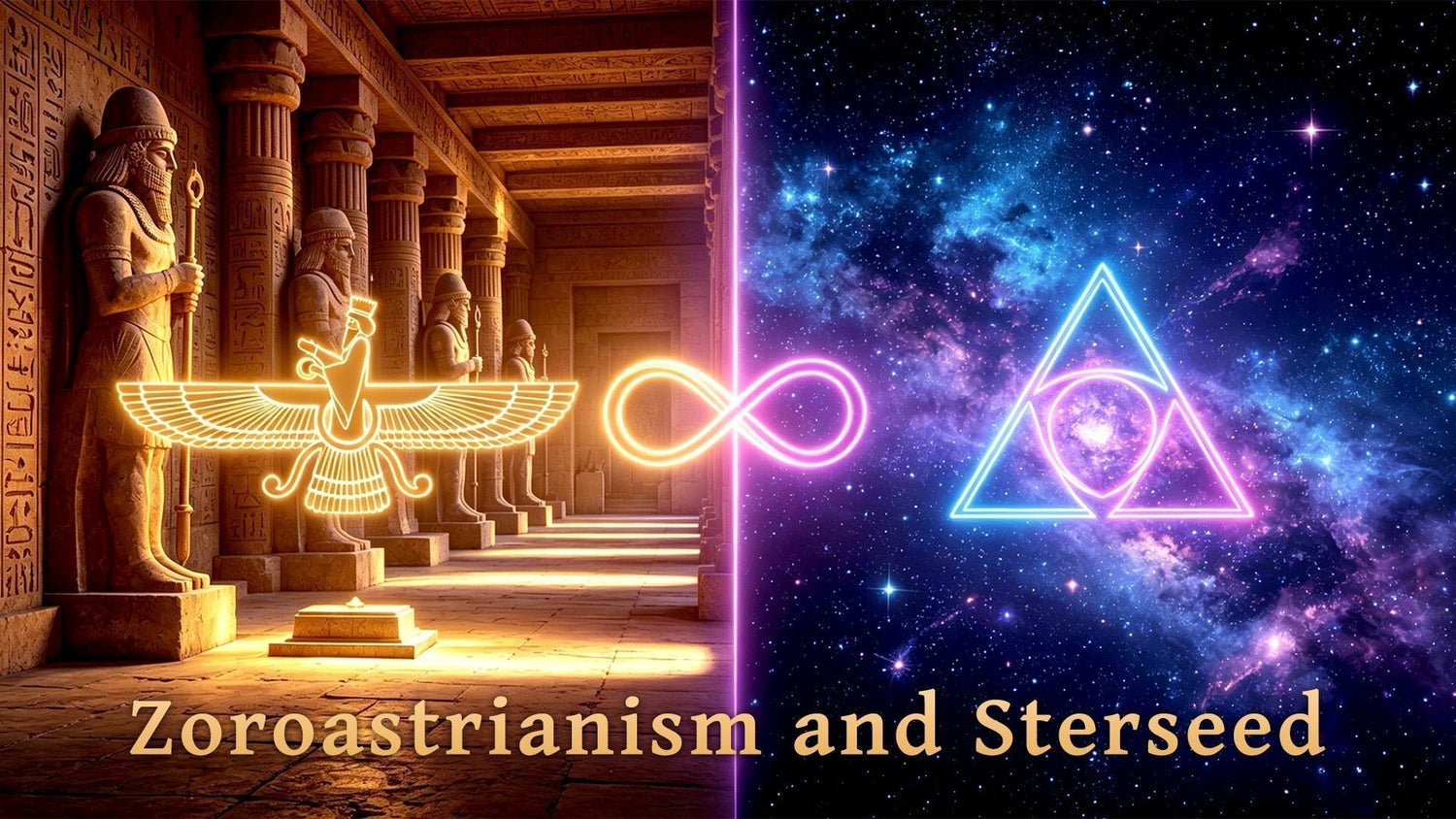
It aligns perfectly with the core narrative of modern starseeds: the soul has a higher origin. It volunteers to come to Earth. The body is just a temporary vehicle. This life is not about drifting along with the current. It's a hidden mission — to awaken, to hold the light, to bridge worlds.
After his awakening, Zarathustra spent years traveling the wilderness, sharing his revelation with anyone who would listen. But most people didn't understand — or didn't want to understand. They saw him as a heretic, a madman.
Only a very few heard the resonance in their souls. They chose to follow him. These followers were later called the "Good Thinkers" — Vohu Manah. And here's what they believed:
The soul comes from the light. By coming to Earth, it forgets its origin.The purpose of life is to remember who you are and find your way back.
Once you awaken, you have a mission: to hold goodness in this chaotic world, to bring light back to this darkened place.

By now, you're feeling a deep sense of familiarity.
That innate sense of not fitting in. That lonely detachment while standing in a crowd. That strange, wordless homesickness when you look at the stars. That longing to wake up, to carry a mission, to save something.
That is, completely and totally, the core of today's starseed narrative.
Three thousand years ago, Zarathustra used words like light and darkness, the origin of the soul to define that loneliness and mission. Three thousand years later, young people use words like source, awakening, starseed identity to describe the exact same feeling.
Eras change. Humans went from riding horses across the steppes to flying above the clouds, from tying knots in ropes to scrolling through feeds with their fingertips. But that wordless tremor in the human heart — the one that whispers "I don't belong here" — has never changed.
Zarathustra and Starseeds: The Same Impulse, Different Names
At this point, you might be wondering: what's the actual relationship between Zarathustra and modern starseeds?
A direct line of inheritance? Probably not. Most young people scrolling through starseed videos on TikTok have likely never heard the name Zarathustra. Their understanding of starseeds comes from Susan Carroll, from Brad Steiger, from Reddit threads — not from the Persian steppes three thousand years ago.
But that's not the point.
The point is this: what Zarathustra felt, and what those people feel today — it's the same thing.
l It's that feeling of "This world shouldn't be like this."
l It's that feeling of "Everyone around me is laughing, but something feels wrong."
l It's that feeling of "I am not just this body and this identity."
l It's that feeling of "I feel like I remember something — but I can't quite grasp it."
This feeling wasn't invented by TikTok. It wasn't invented by starseeds. It wasn't invented by anyone.
It emerges every so often, puts on a new set of clothes, finds a new name, and reappears.
Zarathustra gave his era clothing called Ahura Mazda (the God of Light) and Angra Mainyu (the Spirit of Darkness). His answer was: choose the light, choose the good thought, choose to remember who you are.
Starseeds give today's America clothing called the Pleiades, Sirius, third density, fifth dimension. Their answer is: you are not a native of Earth, you come from somewhere else, and you have a mission.
Different clothes. But what's inside is the same.
Why Bother Retelling Zarathustra's Story Today?
Because if you only look at starseeds themselves, you might conclude: This is just a bunch of people on the internet making up stories, selling crystals, escaping reality. And you'd laugh.
But if you pull back and look at it on a 3,000-year scale, you see something else:
Human beings have never stopped asking the same question.
"Who am I, really? Why am I here?"
Every era gives its generation an answer. Starseeds are this era's answer. It may not be more cosmically correct than any other. But it captures something real — something that gets brutally dismissed as "you're overthinking it" or "you're just depressed."
The answer we're desperately searching for today in the idea of starseeds? Zarathustra was searching for the same thing three thousand years ago. The only difference is, we have the internet to find our resonance. He had only the vast, empty wilderness and the eternal flame.

Why We Need a "Somewhere Else"
When you get down to it, starseeds aren't about outer space. Starseeds are about here.
When someone says "I don't belong here" — what they're really saying is "I can't stand that this is what 'here' is like."
When someone says "My home is somewhere else" — what they're really saying is "Here isn't good enough. This can't be all there is."
When someone says "I came here with a mission" — what they're really saying is "My life has to have a purpose bigger than just surviving."
These feelings weren't invented by starseeds. These are the most basic human feelings there are.
l That feeling of "There has to be more than this."
l That feeling of "Life shouldn't just be work-sleep, work-sleep."
l That feeling of "Something about this world is just not right."
In every era, these feelings need a container.
In Zarathustra's time, the container was called Vohu Manah — the Good Thinker. In the Middle Ages, it was the monastery. In the Puritan era, it was the Promised Land. In the 1960s, it was the Flower Child movement. Today, it's called Starseeds.
The shape of the container keeps changing. But what's inside never does: human restlessness. Human longing. The voice inside that whispers, "I should be more than just this."
So the question — "Are starseeds real?" — is not really the important question.
The important question is: Why do so many people need this idea? Why does the sentence "You might not be from Earth" make so many people exhale with relief?
Because that sentence validates a feeling that has long been dismissed.
You're not overthinking. You're not depressed. You're not too sensitive.
What you feel is real. What you call it doesn't matter. What matters is that it exists.
Those people who tear up watching a video — they're not looking for a scientific theory.
They're looking for permission. Permission to feel like something is wrong. Permission to admit "I don't belong here."
And starseeds give them that permission.
On the steppes of Central Asia three thousand years ago, there were no comment sections, no likes, no "star family." But when that man named Zarathustra looked up at the night sky — he probably teared up, too.
So go ahead and laugh, if that's what you want to do.
But that person scrolling late at night, the one whose eyes sting, the one who quietly takes a screenshot and saves it — they might have just found what they've been looking for.
Not an answer.
A permission.
And maybe — that's enough.


Leave a comment
This site is protected by hCaptcha and the hCaptcha Privacy Policy and Terms of Service apply.